

For most football clubs, a new kit launch follows a familiar formula. A teaser video, a coordinated social drop, a handful of media placements with some players wearing the new kit. It delivers visibility, but rarely cuts through to an audience.
My beloved club, Bradford City approached it differently this year.
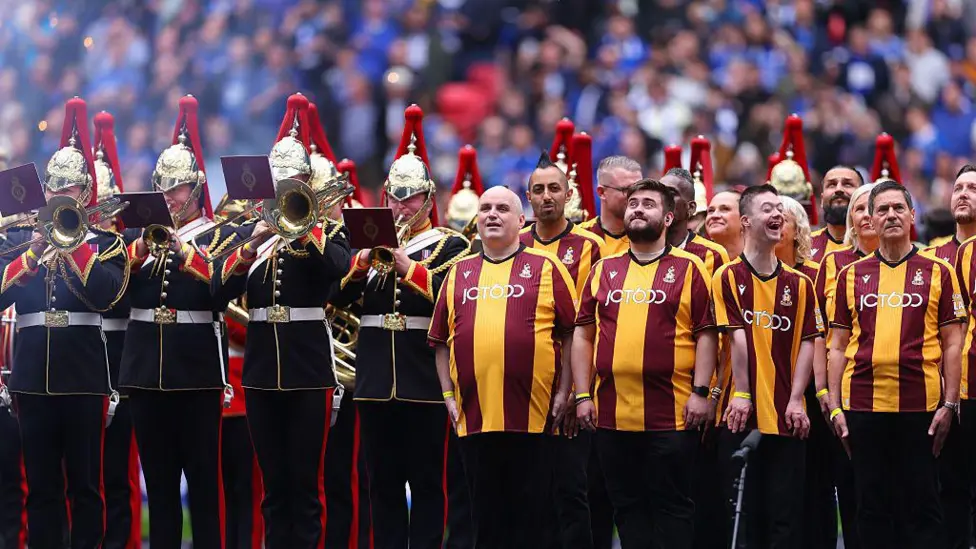
I was fortunate enough to attend 2026 FA Cup Final with a friend and to my own surprise watch my club unveil its new home kit on one of the biggest stages in English sport in a rather unique way.
The kit launch came through the Bantam of the Opera choir, a community initiative led by Chris Kamara to celebrate the city’s year as City of Culture, who performed “Abide With Me” and “God Save the King” at Wembley while wearing the new strip.
What makes this such an effective piece of PR is not just the scale, but how the execution of.
First, it tapped into an existing cultural moment, a staple of the English footballing calendar. Whilst admittedly, the FA Cup Final may not be what it once was for various reasons, it is a globally broadcast event with a built-in audience of millions, offering a level of reach that would be difficult and expensive to replicate through paid media. Rather than building a campaign from scratch, Bradford City embedded itself within an historic moment that already commanded media and fans’ attention. The club took the brand where audiences already were, and placing a brand story there in a way that feels natural. It sparked conversation around me in the Chelsea end of Wembley, “that’s Bradford”, “what are Bradford doing here?”.
Second, the activation was rooted in authenticity. The Bantam of the Opera choir are a group of fans brought together to form the choir in the City of Culture year, with inspiring stories amongst them. A friend of mine’s Grandma, who’s worked at the club for decades, and Aunt form part of the choir they wanted to get involved to meet new people, the group representing a genuine cross-section of the club’s community. By putting them at the heart of the reveal, the club avoided the overly polished feel that often undermines product-led campaigns. Instead, replacing the product with community and culture.
This is where the campaign moves beyond visibility into credibility. Audiences are increasingly sceptical of overt promotion, but they respond to real stories. The choir’s journey from local rehearsals to the Wembley pitch gave the activation emotional weight, and that emotion transferred directly to the product.
There is also a lesson to be learnt here, this was never focussed on the new kit , the hero of this was the moment it generated. This is what made it effective. Rather than pushing a message, the campaign allowed audiences to discover it organically. That approach increases memorability and shareability, because it respects the context rather than interrupting it.
Bradford City may not operate with the same resources or global profile as Man City or Chelsea who played that day, yet the club had placed its brand and story into the same moment with a global audience fixed on our fans and shirt. It achieved exposure on a national and international stage unparallel to anything it could create itself. This underscores a key point, effective PR is not defined by budget, but by insight and execution.
Whilst other clubs use players, global stars and influencers to launch their new kits this summer, I was proud to see my club launch the kit through our own fans at Wembley within such a historic event.
About The Author