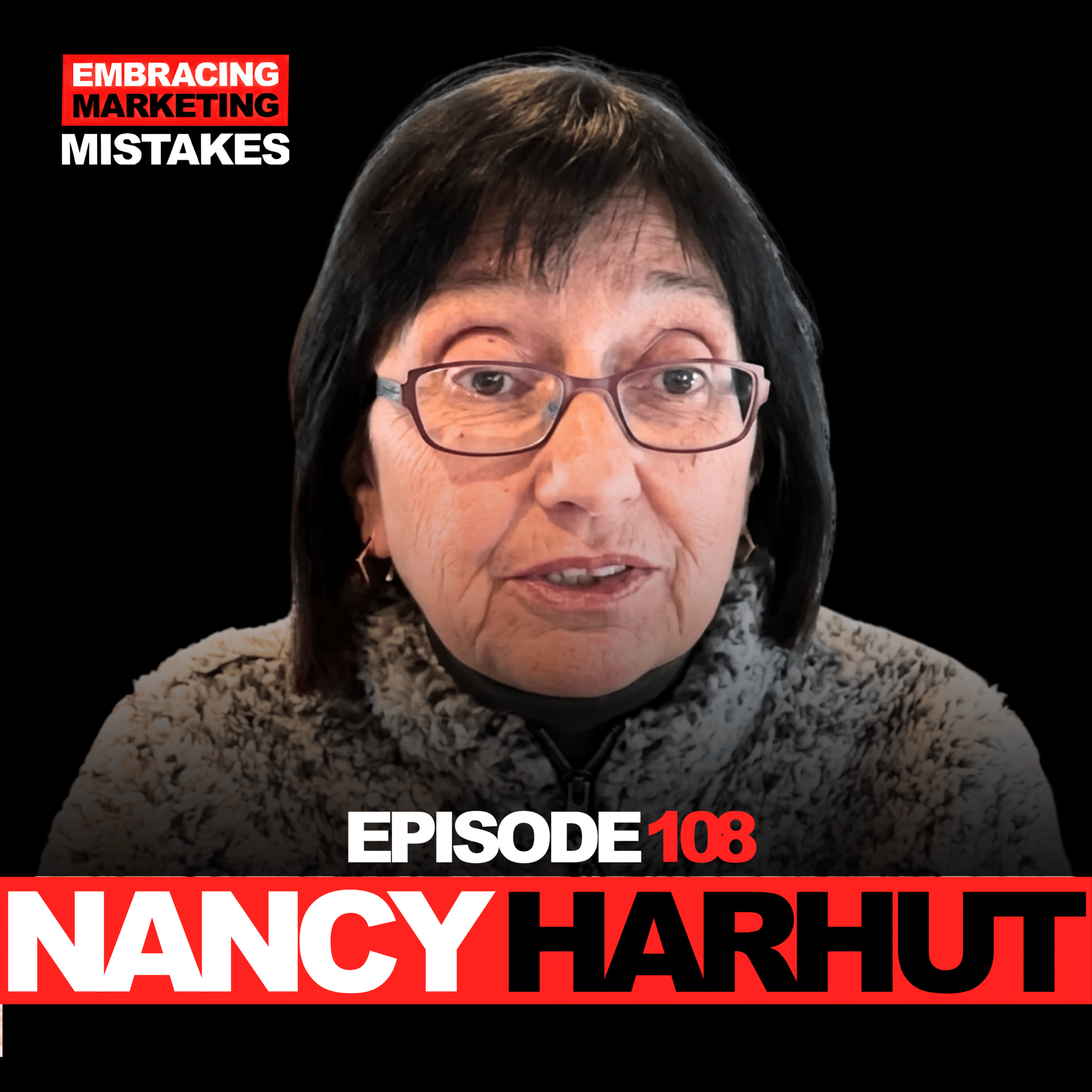

Up to 95% of buying decisions happen in the subconscious. Nancy Harhut explains why customers can’t tell you why they buy, and how small framing changes shift behaviour.
Ask a customer why they bought something and they will give you a confident, logical answer. The problem is it’s usually made up after the fact. We don’t know why we do what we do, so we invent a story that sounds sensible and stick to it.
That is the uncomfortable idea behind my conversation with Nancy Harhut, co-founder and chief creative officer at HBT Marketing and author of Using Behavioral Science in Marketing. She has spent a career proving that people are far less rational than the briefs we write assume. Here is what stuck with me.
Why can’t customers tell you why they buy?
Because up to 95% of buying decisions happen subconsciously. People run on autopilot, then explain the choice afterwards with a tidy story.
Nancy’s point is that we picture our customers weighing the pros and cons, absorbing our carefully crafted messages, and reaching a considered decision. They don’t. They conserve mental energy and fall back on hardwired shortcuts, what she calls decision defaults.
“We have to be wary of believing everything that our customers and prospects tell us.” Nancy Harhut
This matters for anyone running research. If you only act on what people say in a focus group, you will often do the opposite of what actually works. The stated reason and the real driver are two different things.
Does social proof really change what people do?
Yes, and even the experts fall for it. Nancy wrote the book on this and still picked the busier restaurant in Barcelona.
She told me a story I loved. A contact recommended a restaurant in Barcelona, but her hotel concierge nudged her towards the quieter one next door. She walked over to decide for herself. One was dead and the one her friend recommended had a rather large queue out the door. She joined the queue, had a lovely meal, then felt so guilty about the concierge that she went next door for dessert and ended up eating a second dinner.
The issue is that the difference was just timing. One place caught the after-work crowd, the other the late diners. A couple of hours earlier she would have judged the other one the winner. We do what people like us appear to be doing, and we read a crowd as the safe choice.
What is anchoring, and does it actually sell more?
Anchoring is when the first number you see shapes what you do next. A ‘limit 12’ sign on tinned soup nearly doubled how much people bought.
This is my favourite example because it is so counterintuitive. In a study by Wansink, Kent and Hoch, Campbell’s soup went on offer and shoppers bought 3.3 cans on average. Then the researchers added a sign reading ‘limit 12 per person’. Average purchases jumped to seven cans, a 112% increase. It was the exact same soup at the same price. The only change was a number that gave people a starting point to adjust down from.
Most marketers would assume a purchase limit suppresses sales. It does the opposite. The instinct to ‘let them buy as much as they want’ is exactly the instinct the science contradicts.
How should you frame price if people say it’s all about cost?
Don’t race to the bottom. Bundle to reduce the ‘pain of paying’, and show the upgrade as a small extra rather than a bigger total.
Customers will tell you they only care about price. Believe them and you end up the cheapest option, which is rarely sustainable. The science tells a richer story. Paying activates the same bit of the brain as physical pain, so three separate purchases mean three hits of pain. Bundle them under one price and that drops to a single hit, which makes people more likely to buy. People will even pay a premium for the convenience of a bundle.
“Nothing has changed other than how you’ve framed the price.” Nancy Harhut
The sharper trick is differential price framing. In a test using New York Times subscriptions, offering the premium tier as ‘just $7 more’ rather than as a higher total price doubled how many people took it. The maths was identical and only the framing changed.
Where does this leave data and AI?
Data tells you who to talk to and when. Behavioural science tells you how to say it. You need both, and the human spark is the bit AI can’t fake.
Nancy is clear that this isn’t an argument against data. Data science segments the audience and decides which message goes to which person. Behavioural science then shapes that message so the brain actually notices, understands and acts on it. She calls it the one-two punch.
On AI, her take chimed with something the ex-Ogilvy creative Mick Mahoney told me on an earlier episode. AI predicts what comes next from everything that came before, which by definition strips out surprise, originality and the odd human spark that makes a campaign stick. Great for mining the data fast. Not the bit that makes people feel something.
The plays worth testing
If you want the practical takeaways from the episode, here they are:
- Don’t take customer explanations at face value, test what they do
- Use social proof honestly, because a visible crowd reassures people
- Try an anchor, like a suggested quantity, and measure the lift
- Bundle purchases to cut the pain of paying
- Put the discount on the most indulgent item in a bundle
- Frame an upgrade as a small extra, not a bigger total
- Use data to decide who and when, behavioural science to decide how
Listen to the full episode

Watch it on YouTube or listen via embracingmarketingmistakes.co.uk. Nancy’s book Using Behavioural Science in Marketing is worth a read if you want the full set of principles, and Robert Cialdini’s Influence is the classic that started her down this path.
Embracing Marketing Mistakes is the weekly podcast hosted by me and co-director Will Ockenden, where senior marketers share the screw-ups that taught them the most. Over 150 episodes and 375,000 downloads so far.
Here is the thought I keep coming back to. If a sign reading ‘limit 12’ can double soup sales, what is a badly framed price doing to yours right now?
EDITOR NOTES, DELETE BEFORE PUBLISHING
SEO title: The Psychology of Buying Decisions: Nancy Harhut Interview
Meta description: Up to 95% of buying decisions are subconscious. Nancy Harhut explains anchoring, social proof and price framing, with studies you can test in your own marketing.
Slug: psychology-of-buying-decisions-harhut
Schema: Entity Nancy Harhut; Author Chris Norton; Genre Marketing; Creative works Using Behavioral Science in Marketing. (already set)
Fact-check: Campbell’s limit-12 study Wansink, Kent and Hoch, JMR 1998, 3.3 to 7 cans / +112%; Nancy Harhut HBT Marketing, book confirmed.
Note: amended per Chris, first person throughout, Will Ockenden = co-director, 375,000 downloads, inline links to creative and insight pages added.
Waddington check: run and passed.
About The Author