

A business podcast earns attention no blog post can match, but it only produces leads when it sits inside a wider content system that leads somewhere.
We called our first show Socially Unacceptable. We thought it was a great brand name that made us laugh. Absolutely nobody scrolling through Apple Podcasts had the faintest idea what it was about.
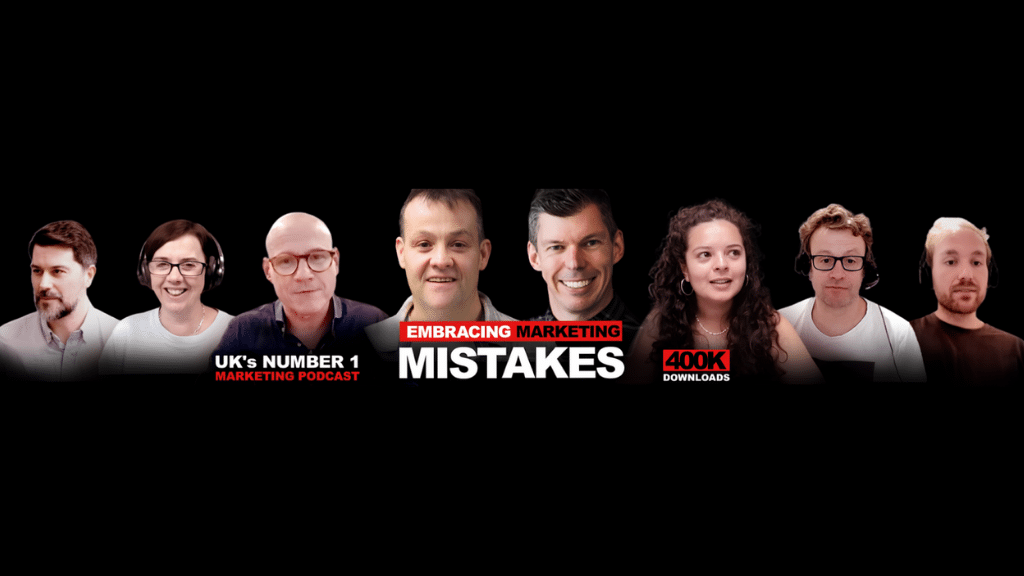
That name cost us listeners for months, and it taught me the most useful lesson in business podcasting: your show gets about two seconds to explain itself. We renamed it Embracing Marketing Mistakes, and the difference showed up almost straight away. In this episode, Will and I took the podcasting webinar we run for clients and turned it into a full walkthrough of how we plan, produce and amplify shows at Prohibition PR.
Why does a B2B podcast hold attention when other content struggles?
Because the format buys you time. Nielsen research has put completion rates at roughly eight in ten listeners staying for all or most of an episode, which is a level of attention a blog post is never going to get.
Compare the numbers honestly. A blog post might hold someone for five minutes. A social post gets three seconds if you are lucky. An episode can hold a senior buyer for the better part of an hour, once a week, while they are driving or doing the washing up.
The washing up is the interesting bit. Podcasting is what Will calls a companion medium, something people consume while their hands are busy with something else. That is why the attention is so generous and also why it is so hard to convert.
“A companion medium is the idea that you use your podcast while you’re doing something else. That means it’s quite hard to get your audience to take an action. If somebody’s washing up and listening to a podcast, you’re not going to get them to hit subscribe or click or purchase.” Will Ockenden
Why do most business podcasts never generate a single lead?
Because they sit on their own. A podcast in isolation rarely drives revenue. It has to feed a funnel of email, social and short-form content that gives people somewhere to go.
We have this conversation with brands constantly. They have a genuinely good show, thousands of listeners, guests they are proud of, and nothing arriving in the sales pipeline. The show is doing its job. Everything around it is missing.
The fix is unglamorous. Your podcast sets the agenda for a month of content. An email newsletter references the episode. Clips go out on social and point back to a landing page. A written piece expands on the theme and links to your core offer. On its own the show builds trust; hooked into that system it starts producing enquiries. We have picked up several clients directly off the back of ours, and every one of them came through that chain rather than from the audio itself.
Podcasting also has no discovery engine worth the name. Social feeds serve you content whether you asked for it or not. Podcast apps mostly wait for you to come looking. Recent industry data suggests social and video platforms now account for well over half of all podcast discovery, which tells you where the work has to happen.
What makes a podcast premise clear enough to get found?
Three things, stated plainly in the name and description: who the show is for, what it does for them, and how. If a listener cannot work that out at a glance, they scroll past.
We keep coming back to an example that looks almost comically dull. TLT LLP, a law firm, runs a podcast about employment law updates. The name is functional, the description is functional, and it sits in the top ten legal podcasts. It does exactly what it says on the tin, and for a specialist audience that is the whole point.
Compare that with what we did. Socially Unacceptable was a creative name from a creative/PR agency, and the description said something vague about covering everything in marketing with a twist. It worked well enough. It would have worked considerably better if it had told people the show was about marketing failures, which is what it was actually about all along.
Be specific about the audience. “Senior food and beverage buyers in UK grocery multiples” beats “marketers”. Then say what value you bring them. That level of detail feels uncomfortably narrow when you write it down, and it is the reason the right people find you.
How much kit do you actually need to start?
Ten pounds a month gets you going. Fifteen dollars a month gets you something respectable. Everything above that is a production decision, not a starting requirement.
If you are testing the idea, record over Google Meet, save to Drive and use a headset mic. You will get an as-live MP4 for about a tenner a month. It is basic, and it is enough to find out whether anyone wants to listen. Stephen Bartlett started out with just a mic under his bedsheets – I know cause I listened back then.
The step up is a platform like Riverside, around fifteen dollars a month, which records natively to each participant’s machine. That detail has saved us more than once. We have interviewed people on genuinely awful connections, sat there wincing as it goes all blocky, then found the edit was perfectly clean because the audio never went near the internet until the call ended.
Our own studio setup runs to a mixing desk, a microphone per guest, a camera on each person plus a wide, and a soundproofed boardroom. It has cost well north of fifty thousand pounds and a video team to run it. Nobody needs that to start. We built it because we produce shows for clients, and because I wanted to practise what we preach.
What are the biggest mistakes brands make with podcasting?
Quitting too early. Nothing else on the list comes close, and the drop-off happens far sooner than most brands expect.
Podnews has reported the pattern as the 90/90 rule: around 90% of podcasts stop publishing after episode three, and of the survivors, roughly 90% stop by episode twenty. Reach episode thirty, and you are already in rare company. People give up because episodes one to three produce almost no feedback, so it feels like shouting into a cupboard.
The mistakes we see most often:
- Not playing the long game. Record three or four episodes before you launch so the schedule never wobbles in the first month.
- No clear structure. Pick a format, interview or co-host or solo, and stick with it. Listeners learn the shape of a show and get comfortable in it.
- Publishing too infrequently. Weekly beats fortnightly. Fortnightly is a perfectly sensible way to start. Anything less regular and you fall out of people’s routines.
- Overselling. A show that is an advert for your product every week will lose the audience that makes it worth doing.
- Booking the wrong guests. I turned down a CFO recently who wanted to come on a marketing podcast to talk about their product. Relevance to your audience beats a good CV every time.
On guests, the honest advice is that appearing on other people’s shows will do more for your download numbers than almost anything else you try. We interviewed Paul Sutton, who used to host the Digital Download podcast, and he later shared our episode on his own feed. That single act moved our numbers more than a fortnight of paid promotion.
Is podcasting worth a place in next year’s marketing plan?
For most B2B brands, yes, provided you treat it as a content engine rather than a single channel.
One hour in a room produces the audio episode, a long-form video, YouTube shorts, social clips, still images, a transcript, and written content built from that transcript. Very little else in marketing gives you that much from one session.
The trust argument matters more than the volume one, though. UK B2B decision makers increasingly use podcasts to pick up business content, and an hour of someone’s undivided attention does something to a relationship that a case study PDF cannot. People arrive at our meetings already knowing how Will and I think about things. That shortens conversations considerably.
Listen to the full episode

You can also find the episode on the Embracing Marketing Mistakes YouTube channel or at embracingmarketingmistakes.co.uk.
Embracing Marketing Mistakes is the weekly podcast I host with my Prohibition PR co-director Will Ockenden, where senior marketers tell us about the campaigns that went wrong and what they learned putting them right.
So what would your show actually be called? If you cannot answer that in six words, you are not ready to press record yet.
About The Author